
Competence Creates Accountability
Why capable people make comfortable environments uncomfortable.

There is a moment that happens and it’s subtle.
No announcement. No strategy meeting. No leadership memo.
Just a quiet shift in the room.
Someone competent shows up.
And suddenly things that were previously described as “complicated,” “unclear,” or “just the way it is” begin to look suspiciously solvable.
In this moment competence becomes inconvenient.
Because competence doesn’t just improve performance.
It raises the standard.
And once the standard moves, the system can no longer pretend the old limitations were inevitable.
Research on organizational performance consistently shows that clarity around roles, processes, and accountability is one of the strongest predictors of effective teams (Rodrigues, Butler, & Guest, 2022).
The Comfort of Low Expectations
Most systems operate inside an unspoken agreement of comfortability.
The agreement sounds something like this: Things are messy, but everyone is doing their best.
Which is often true... and that explanation quietly protects broken structure.
When something fails, the explanation tends to orbit around effort:
“We’re overwhelmed.”
“Communication broke down”
“This process is just complicated.”
The narrative survives because no one has demonstrated anything different.
Then someone competent enters the system.
They ask irritatingly simple questions:
Where does this request actually go?
Why are we documenting this three different ways?
Who owns this step?
Suddenly, the problem no longer looks mysterious; they look almost designed.
Organizational research often shows that what appears to be “people problems” are frequently structural design problems in disguise (Gallup, 2023). And once a problem looks designed, people start wondering why it hasn’t been redesigned.
That’s when accountability quietly enters the chat.
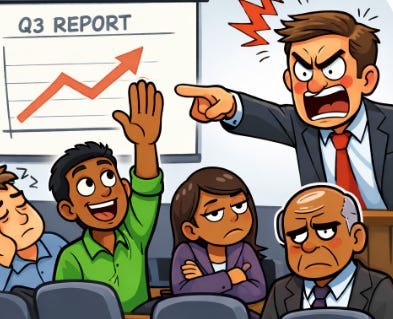
Competence Kills the Escape Hatch
Ambiguity is the great protector of dysfunctional systems.
If nobody understands how something works, nobody is responsible when it doesn’t.
Competence disrupts that arrangement.
A capable person can demonstrate that the task that supposedly “takes three days” can actually be resolved in thirty minutes.
A clean workflow removes entire categories of recurring problems.
A simple metric exposes patterns that were hiding in plain sight.
Studies on governance and process clarity show that once systems are documented and measurable, performance differences and inefficiencies become far more visible (Shao, Feng, & Hu, 2023).
And clarity ruins the story that nothing can be done.
Why Competence Creates Resistance
Here’s the awkward part.
Improvement is not always welcomed.
When competence enters a system, it doesn’t just fix things.
It reveals what the system was tolerating.
Some people find that energizing.
Others find it deeply uncomfortable. Not because they’re lazy. But because clarity changes the rules of the game.
Research on psychological safety shows that when systems become more transparent, people often experience short-term discomfort before long-term improvement (Newman, Donohue, & Eva, 2020; Edmondson, 2021).
The system didn’t suddenly become harsher.
It simply became harder to hide in.
And visibility creates accountability.
The Competence Ripple Effect
Competence rarely stays contained.
Once one part of a system becomes clear, the surrounding pieces begin to shift.
A documented workflow exposes upstream confusion.
A reliable metric reveals downstream bottlenecks.
A stable process exposes work that was never necessary in the first place.
Clarity spreads.
Expectations rise.
Once people experience what a functional system feels like, it becomes very difficult to return to chaos.
Not impossible, but it is uncomfortable.
This Happens in Personal Life Too
Competence isn’t just an organizational phenomenon.
It shows up in everyday life.
The friend who communicates clearly changes the tone of the group.
The person who sets boundaries changes the dynamic of the relationship.
The individual who organizes something well becomes the unofficial planner forever.
Competence has gravity.
Once people see what clarity looks like, they begin expecting it.
Sometimes from the system.
Sometimes from the person who introduced it.
The same dynamic appears in social and professional environments: when individuals introduce structure or clarity, expectations across the group tend to shift upward (World Economic Forum, 2024).
The Real Reason Standards Rise
Competence proves something dangerous: Improvement was always possible.
And once something becomes possible, the old limitations start looking less like constraints and more like choices.
That’s why capable people often feel pressure increase after they succeed.
The standard has moved.
Everyone has now seen what “good” actually looks like.
Once that line is visible, it rarely moves backward.
The Quiet Truth
One person asks a clearer question.
One small fix improves the profession.
A process works better than before.
And suddenly the excuses don’t land anymore.
Because once something works right,
The fog loses its fight.
Competence doesn’t shout or accuse.
It just makes it harder to excuse.
References
Edmondson, A. C. (2021). The Fearless Organization: Creating Psychological Safety in the Workplace for Learning, Innovation, and Growth. Wiley.
Gallup. (2023). State of the Global Workplace Report.
Newman, A., Donohue, R., & Eva, N. (2020). Psychological safety: A systematic review of the literature. Human Resource Management Review, 30(2).
Rodrigues, R., Butler, C., & Guest, D. (2022). The role of clarity and accountability in organizational performance. Journal of Organizational Behavior.
Shao, Z., Feng, Y., & Hu, Q. (2023). Impact of process clarity and governance structures on organizational performance. Information & Management.
World Economic Forum. (2024). Future of Jobs Report.
Компетентность как угроза — это не метафора. Она буквально делает невидимое видимым: проблемы, которые все называли "неизбежными", вдруг оказываются просто плохо устроенными. Это убирает alibi у системы. Именно поэтому компетентный человек часто встречает сопротивление там, где ждёт благодарности. Стандарт сдвинулся — и назад его не задвинуть. — @lintara